

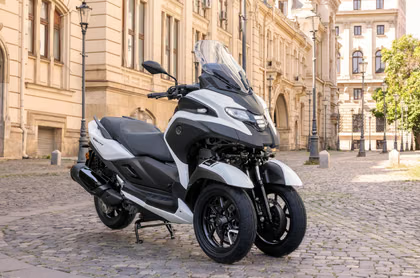
Pick up a motorcycle magazine from fifteen years ago and compare the specification sheet of a typical mid-range motorcycle with what a similarly priced bike offers today. The difference is genuinely striking. What was a cutting-edge feature available only on high-end European and Japanese superbikes in 2010 is now standard or near-standard equipment on motorcycles that a first-time buyer considers in the Indian market. The pace of technological development in motorcycles has accelerated dramatically and shows no signs of slowing.
Some of this is driven by safety regulation. The mandatory introduction of ABS in India from 2019 onward pushed antilock braking from an optional extra to a baseline requirement. Fuel injection replaced carburettors not because riders demanded it but because emission norms made carburettors unviable. But a significant portion of the technology that has entered motorcycles in recent years is there because it genuinely improves the riding experience, increases safety, or enables capabilities that were not previously available at any price point.
Understanding motorcycle technology matters for riders at every level. It matters for the informed purchase decision, knowing what the features you are reading about in the specification sheet actually do and whether they matter for how you plan to use the motorcycle. It matters for getting the most out of a motorcycle you already own by understanding what its systems are doing and how to use them effectively. And it matters simply as a motorcycle enthusiast who finds the engineering of these machines genuinely interesting.
This blog is going to cover the most significant technology developments in motorcycles in plain, accessible language. What each technology does, how it works at a level that is useful without being overwhelming, why it matters for real-world riding, and where the technology is heading next.
Engine Technology: Power Delivery That Has Changed Everything
The motorcycle engine has been continuously refined for over a century but the rate of refinement in the past two decades has been extraordinary. The combination of fuel injection, variable valve timing, liquid cooling, and sophisticated engine management systems has produced engines that are more powerful, more fuel efficient, cleaner, and more reliable than their predecessors while also being more tractable and more enjoyable to use across a wider range of conditions.
Fuel injection replaced carburettors across the motorcycle market with remarkable speed once emission regulations made the change necessary. The benefits of fuel injection go well beyond compliance with emission norms, though that was the primary driver of adoption. A fuel-injected engine delivers fuel with precision that a carburettor cannot match. The system continuously adjusts fuel delivery based on throttle position, engine speed, air temperature, barometric pressure, and multiple other inputs to deliver exactly the right amount of fuel for the current conditions at every moment of operation. The result is crisper throttle response, more consistent power delivery, better fuel economy, easier cold starting, and reliable operation at altitude where a carburettor’s fixed jetting would be running too rich.
Variable valve timing, which has been used in car engines for years, has arrived in motorcycle engines and the results are significant. A conventional engine has valve timing that is fixed as a compromise between low-speed torque and high-speed power. Variable valve timing allows the engine management system to optimise valve timing for different operating conditions, delivering strong low-speed torque for urban riding and access to the engine’s full power capability at higher speeds. Yamaha’s Variable Valve Actuation system used in the R15 V4 is a notable example of this technology reaching an accessible price point in the Indian market and the difference it makes to the R15’s usable power delivery across the rev range is genuinely meaningful.
Liquid cooling has become the standard for performance-oriented motorcycles and increasingly for mid-range bikes that need to meet stringent emission and temperature norms. A liquid-cooled engine maintains more consistent operating temperatures than an air-cooled one, which benefits both performance consistency and long-term engine health. It allows closer manufacturing tolerances, which improves efficiency and reduces emissions. And it runs cooler for the rider in traffic conditions where an air-cooled engine can produce significant heat toward the rider’s legs, which is a practical benefit that anyone who has ridden an air-cooled motorcycle in urban traffic in Indian summer will appreciate immediately.
The Royal Enfield 452cc liquid-cooled engine in the Himalayan 450 and Guerrilla 450 represents a significant step in bringing modern engine technology to a brand whose identity had been closely tied to the character of its older air-cooled units. The new engine produces its power more smoothly, more consistently, and with better throttle response than its predecessor while also running cleaner and meeting current emission requirements without the rough edges that tuning an older design for compliance tends to introduce.
Electronics: The Revolution That Changed Motorcycle Safety
The electronics revolution in motorcycles has arguably done more to improve both safety and riding experience than any other single area of technological development. The computing power available in a modern motorcycle’s electronics package would have seemed extraordinary even fifteen years ago and it is being applied to problems that previous generations of riders simply had to manage through skill and experience alone.
Antilock Braking Systems are now so widely understood that it is easy to forget how significant their introduction was. ABS prevents wheel lockup during emergency braking by monitoring wheel speed and modulating brake pressure many times per second to keep the wheels rolling rather than sliding. A locked wheel provides no directional control and a locked front wheel in particular will almost always result in a crash. ABS removes this outcome from the equation in most emergency braking situations, allowing the rider to brake as hard as conditions require without the skill required to modulate pressure at the exact threshold of lockup. The real-world safety impact of mandatory ABS introduction has been clearly demonstrated in accident data across multiple countries and India’s own data since 2019 is consistent with the international evidence.
Cornering ABS, which is a more sophisticated evolution of the basic ABS system, extends the protection into cornering situations. A basic ABS system calibrated for straight-line braking can interfere with braking while leaned over in a corner because the wheel speed differential that the system interprets as impending lockup may simply reflect the motorcycle’s lean angle rather than actual loss of traction. Cornering ABS systems incorporate inertial measurement units that provide information about the motorcycle’s lean angle and use this to adjust how the system intervenes, allowing effective ABS protection even when braking while cornering. This technology was previously found only on high-end European motorcycles and has now reached more accessible price points through its inclusion in models like the KTM 390 Adventure and selected Bajaj and Triumph models.
Traction Control Systems prevent the rear wheel from spinning under acceleration by monitoring the speed of both wheels and reducing power delivery or ignition timing when the rear wheel is spinning faster than the front. This is most relevant in wet conditions, on loose surfaces, or when exiting slow corners with significant throttle. For riders who push their motorcycles in varied conditions, traction control provides a safety margin that skill alone cannot guarantee with the same reliability. The sophistication of traction control systems varies from simple on-off implementations to multi-level systems that allow the rider to choose how aggressively the system intervenes, with higher intervention levels for difficult conditions and lower intervention levels for conditions where the rider wants to use a controlled amount of rear wheel spin.
Riding modes are perhaps the most user-visible expression of the electronics package in a modern motorcycle. A riding mode is a pre-configured set of parameters including power delivery character, traction control intervention level, ABS sensitivity, and sometimes suspension settings that can be selected by the rider at the press of a button. Rain mode typically softens power delivery and increases electronic intervention levels. Sport mode typically provides sharper throttle response and allows more wheel slip before intervention. Custom modes available on some motorcycles allow the rider to configure their own combination of parameters. The ability to match the motorcycle’s behaviour to the current conditions with a button press is genuinely useful in the real world and not simply a feature to list in a brochure.
The Inertial Measurement Unit, commonly called the IMU, is the component that makes the more sophisticated electronic systems possible. An IMU measures the motorcycle’s movement in multiple axes simultaneously, providing information about lean angle, pitch, and roll that the electronics package uses to make better decisions in systems like cornering ABS, cornering traction control, and wheelie control. The availability of IMU-based systems has moved progressively down the price range as the cost of the components has reduced, and motorcycles in the mid-range Indian market are now increasingly equipped with capabilities that were premium features only a few years ago.
Suspension Technology: How Modern Bikes Handle the Road
Suspension technology has developed significantly in the past decade with improvements that affect both comfort on varied surfaces and handling precision in performance riding.
USD forks, which stands for Upside Down forks, have become standard equipment on performance motorcycles and are increasingly found on adventure bikes and roadsters. The USD configuration places the larger diameter tube at the top, attached to the triple clamp, and the smaller tube at the bottom, attached to the wheel. This configuration is stiffer than the conventional right-side-up arrangement, which improves handling precision under braking and cornering, while also reducing unsprung weight at the wheel end of the fork, which improves the fork’s ability to follow road surface variations. USD forks also look more purposeful than conventional forks, which has made them an aspirational visual feature that manufacturers have been happy to provide across an expanding range of motorcycles.
Semi-active suspension is one of the most significant developments in motorcycle dynamics technology and has moved progressively from very high-end motorcycles toward the upper mid-range over the past five years. A conventional suspension system uses fixed valving that is set as a compromise between comfort and handling performance. Semi-active suspension uses electronically controlled valves that can change the damping characteristics of the suspension in real time based on inputs from the IMU and other sensors. The system can firm up the suspension when it detects hard braking to prevent nose dive, soften it when it detects rough road surfaces to improve comfort, and adjust it continuously as conditions change. The result is suspension performance that is genuinely better than fixed-rate suspension in both comfort and handling terms, which is an unusual combination because the two objectives usually require compromise in conventional suspension design.
WP suspension, which is the suspension brand associated with KTM and now appearing on Husqvarna and some Bajaj Triumph models, has become a benchmark for suspension quality at accessible price points. The fully adjustable WP units offered on models like the KTM 390 Adventure allow riders to tune preload and damping settings to their weight, riding style, and intended use, which is a level of adjustability that was previously found only on significantly more expensive motorcycles.
Connectivity and Instrumentation: The Digital Cockpit
The instrument cluster of a modern motorcycle has been transformed from an analogue speedometer and a fuel gauge into what is effectively a smartphone interface for the motorcycle, providing navigation, connectivity, ride data, and system information in a format that keeps the rider informed without requiring them to take their eyes off the road.
TFT displays have replaced analogue and basic LCD instrument clusters across an increasing range of motorcycles. A TFT display provides sharp, clear, configurable information that remains readable in direct sunlight through its backlight technology. The ability to configure what information is displayed, to switch between different display layouts, and to access deeper system information through menu navigation gives riders control over their information environment that previous instrument designs did not offer.
Bluetooth connectivity between the motorcycle’s instrument cluster and the rider’s smartphone allows features that have become standard expectations in the segment. Turn-by-turn navigation displayed on the instrument cluster means the rider can follow a route without a dedicated GPS unit or a phone mount in their sightline. Incoming call notifications and music control via controls on the handlebars allows the rider to manage their communication without removing their hands from the controls. Service reminders, fuel range calculations, and ride data logging that can be reviewed and shared through associated smartphone applications add further utility to the connected motorcycle.
The Royal Enfield Himalayan 450’s Tripper navigation display, which provides a simple turn-by-turn navigation indication through a dedicated circular screen alongside the main instrument cluster, is a practical and well-executed example of navigation connectivity at a mid-range price point. The simplicity of a dedicated navigation display that does one thing very well, rather than integrating navigation into a complex multifunction display, reflects an understanding of what riders actually need while riding.
USB and USB-C charging ports, which allow riders to charge their phones and other devices while riding, have become standard equipment on motorcycles across price ranges. In an era when the phone serves as navigation device, music player, and communication tool while touring, the ability to maintain charge without carrying external battery packs is a practical convenience that quickly moves from nice-to-have to expected.
Braking Technology Beyond ABS
The braking systems of modern motorcycles have developed significantly beyond the introduction of ABS, with technologies that improve stopping power, fade resistance, and feel across a range of demanding conditions.
Cornering braking control, which is sometimes called Combined Braking Systems or CBS and sometimes implemented as part of a more comprehensive cornering ABS package, manages the distribution of braking force between front and rear brakes to optimise stability and effectiveness in different braking scenarios. The system can provide more rear braking contribution when braking in a straight line and adjust the distribution as lean angle changes to maintain stability through the full range of braking situations.
Radially mounted brake calipers, which were once found only on high-performance superbikes, have become standard equipment on performance-oriented mid-range motorcycles and are increasingly found on adventure and roadster bikes. The radial mounting configuration provides a more rigid caliper-to-fork connection than the axially mounted alternative, which translates directly into better braking feel and more consistent braking performance, particularly at high temperatures.
Braided brake lines replace the rubber hoses of conventional braking systems with stainless steel reinforced hoses that expand significantly less under braking pressure than rubber. The result is more consistent brake feel and more direct pressure-to-deceleration relationship that performance riders find meaningful, particularly in demanding situations where consistent feedback from the braking system is important for confidence and control.
Tyre Technology: The Foundation of Everything
Tyre technology is the area of motorcycle development that affects every aspect of performance, safety, and comfort and that receives less attention in launch coverage than it deserves.
Radial tyres have replaced crossply construction across the performance segment and are increasingly standard on mid-range motorcycles. A radial tyre has cords that run perpendicular to the direction of travel rather than at an angle, which produces a tyre that runs cooler, provides better contact patch consistency, and delivers more predictable handling than crossply alternatives. For performance riding the advantages of radial construction are meaningful in terms of both performance and safety.
Dual compound tyres, which use a harder rubber compound in the central strip of the tyre that contacts the road during straight-line riding and a softer compound on the shoulders that contact the road during cornering, optimise tyre life and cornering grip simultaneously. The harder centre compound provides better mileage where mileage is most important, in straight-line cruising, while the softer shoulder compound provides the grip where grip is most important, at lean in cornering. This technology, which is now standard on sport tyres and increasingly found on touring and adventure tyres, represents a meaningful engineering solution to the traditional compromise between tyre life and performance.
Tubeless tyres across the board have simplified puncture management for riders significantly. A tubeless tyre can be repaired with a simple plug kit in most puncture situations without the wheel removal and tube repair that a tubed tyre requires. The tyre also deflates more slowly in the event of a puncture, giving the rider more time and stability to bring the motorcycle to a controlled stop. The adoption of tubeless tyres across virtually all segments of the market is one of the most practically beneficial changes in motorcycle technology for everyday riders.
Electric Motorcycles: The Technology Frontier
The electric motorcycle segment is the most rapidly evolving area of motorcycle technology and understanding where it currently stands is important for anyone forming views about the future direction of the two-wheeler market.
Electric motors offer characteristics that are genuinely different from internal combustion engines in ways that affect the riding experience significantly. Instant torque from zero rpm means that throttle response is immediate and linear rather than dependent on the engine reaching a productive operating speed. The absence of a gearbox on most electric motorcycles removes the need for clutch operation and gear selection, simplifying the riding task and making electric motorcycles accessible to new riders in a way that reduces the learning curve. The silence of electric operation is one of the most frequently discussed characteristics and rider responses to it are divided between those who miss the sound of a combustion engine as an intrinsic part of the motorcycle experience and those who find the quiet operation liberating.
Battery technology is the area that most constrains the current electric motorcycle proposition and the area where development is most active. Current lithium-ion battery technology provides energy density that is significantly lower than that of petrol, which means that achieving comparable range to a petrol motorcycle requires either accepting reduced range or carrying battery weight that is significantly greater than the fuel weight it replaces. The rapid development of battery chemistry, with solid-state batteries representing the most promising next-generation technology, is expected to improve energy density significantly over the next several years, which will change the range and weight equation in ways that make electric motorcycles more competitive with petrol alternatives.
The charging infrastructure challenge is particularly significant for motorcycle users compared to car users because motorcycles typically do not have the secure overnight parking situations that allow convenient overnight home charging. The development of fast-charging capability that can restore significant range in fifteen to thirty minutes, and the expansion of public charging infrastructure, are both necessary for electric motorcycles to become genuinely practical for the full range of use cases that petrol motorcycles currently serve.
Ather Energy and Ola Electric in India have demonstrated what is achievable in the electric scooter segment and the lessons of their development are being applied as both companies and new entrants develop electric motorcycle products that go beyond the scooter segment. The Royal Enfield Flying Flea concept, the anticipated electric offerings from Bajaj and TVS, and the entry of established international electric motorcycle brands into the Indian market will together define the next phase of electric two-wheeler development in the country.
What Comes Next: Technologies on the Horizon
Several technologies that are currently in development or in early adoption will shape the motorcycle of the next decade in ways that are worth understanding.
Radar-based systems are beginning to appear on premium motorcycles with adaptive cruise control that maintains a set following distance from the vehicle ahead automatically. Blind spot monitoring that alerts the rider to vehicles in adjacent lanes that cannot be seen in mirrors is another radar-enabled feature that is entering the segment. These technologies, which have been standard in premium cars for several years, will filter down through the motorcycle market with the same progressive adoption pattern that has characterised every previous technology in the segment.
Vehicle-to-vehicle and vehicle-to-infrastructure communication, which allows motorcycles to receive and share information about road conditions, traffic, hazards, and other relevant data with other connected vehicles and infrastructure, is in development and early testing. The potential safety benefits of a motorcycle that can warn the rider of a hazard around a bend before the rider can see it are significant and this technology is likely to become increasingly relevant over the next decade.
Advanced rider assistance systems that go beyond current electronic aids to provide more comprehensive intervention and guidance are in development by multiple manufacturers. Predictive systems that identify potential collision scenarios before the rider has reacted and begin preparing intervention, lane-keeping assistance for highway riding, and automatic emergency braking are all technologies that are closer to production reality than most riders currently expect.
Conclusion
Motorcycle technology has developed at a pace over the past decade that has genuinely transformed what a motorcycle is and what it can do. The combination of sophisticated engine management, comprehensive electronic rider aids, improved suspension systems, connected instrumentation, and continuously developing tyre technology has produced motorcycles that are safer, more capable, more efficient, and more enjoyable to ride than anything that came before them at equivalent price points.
The most important thing for riders to understand about motorcycle technology is that it exists to serve the riding experience rather than to replace rider skill and judgment. ABS does not remove the need to brake properly. Traction control does not remove the need to manage throttle application with care. Riding modes do not substitute for understanding the conditions you are riding in and adjusting your behaviour appropriately. The technology provides safety margins and performance enhancements within which skilled riding still matters and still makes the difference between a good ride and a great one.
For buyers in the market for a new motorcycle, understanding which technologies genuinely matter for how you intend to use the bike and which are attractive in a brochure but irrelevant to your riding is the key to making a purchase decision that you will be satisfied with over years of ownership. ABS matters for almost everyone. Cornering ABS matters more for those who ride aggressively in varied conditions. Riding modes add real value for those who ride across significantly different conditions. Semi-active suspension is transformative for those who ride both on and off road. Connectivity features matter more or less depending on how much you use your phone for navigation and communication while riding.
The motorcycle industry is in one of its most exciting technological periods and the pace of development is not slowing. The electric transition, while still in its early stages for motorcycles, will bring a new set of technological conversations over the next decade. The progressive adoption of radar, vehicle communication, and advanced rider assistance systems will continue to expand what electronic technology can do for rider safety. And the continued refinement of existing technologies in engine management, suspension, and electronics will keep pushing the standard of what a given budget buys in motorcycle capability upward.
It is a genuinely remarkable time to be a motorcycle rider and to follow what the engineers and designers who build these machines are capable of producing. Pay attention to the technology. Understand what it does. And then go and ride the bikes that carry it with the appreciation they deserve.
The motorcycle has always been one of the most direct expressions of engineering excellence available at human scale. In 2026, that has never been more true.